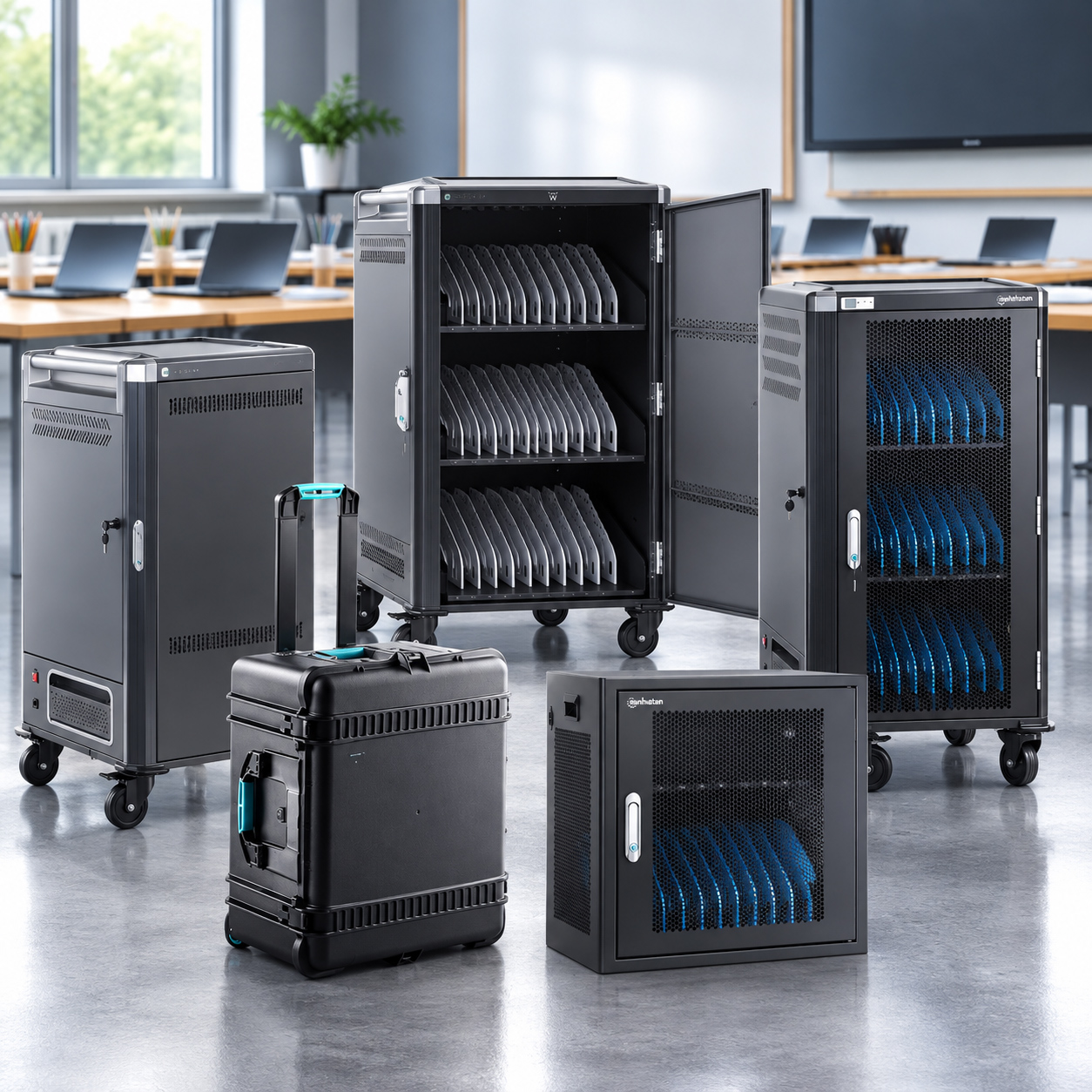
Laptops and tablets are standard equipment in schools, offices, public institutions and computer labs. As the fleet grows, finding somewhere to store and charge it becomes harder. A dozen adapters plugged into sockets around a room soon leave staff dealing with tangled leads and missing chargers.
One option is to use charging cabinets and stations with 230 V AC sockets. They keep devices together and give each charger a permanent connection, so users can return a laptop to its slot after use.
Netinet offers models for different settings. Our top five vary in capacity, ventilation, charging controls and ease of transport.
What is an AC charging cabinet?
An AC charging cabinet is a lockable unit with individual spaces for laptops, tablets or other devices and a set of 230 V AC outlets. Place the devices in their slots, plug in their adapters and start charging.
Standard 230 V sockets accept the devices’ original power adapters. This is particularly useful for laptops with higher power requirements or dedicated chargers.
One cabinet serves several purposes. It keeps devices and cables organised, provides secure storage and charges a fleet in one place.
Depending on the model, it may also offer active or passive ventilation, sequential charging and additional electrical protection.
Where are laptop charging cabinets used?
A familiar example is schools and other education settings, where one class may share dozens of laptops. At the end of a lesson, the devices can go back in the cabinet to charge.
Other settings include
- offices and training rooms,
- local authorities and public institutions,
- computer labs,
- libraries and learning centres,
- businesses that issue shared equipment to staff,
- and sites where devices move regularly between rooms or buildings.
Central storage is especially useful when several people share the same equipment. Staff can prepare the entire set in one place and spend less time looking for free sockets or untangling leads.
Charging cabinets and Poland’s digital education programmes
Polish programmes such as Cyfrowy Uczeń (Digital Student) and Laboratoria Przyszłości (Laboratories of the Future) help schools expand their digital infrastructure. As schools add laptops and tablets, they also need somewhere to store and charge them.
Charging cabinets with 230 V AC sockets meet that practical need. They keep equipment together, ready for the next lesson. Different capacities and layouts suit both full-size computer labs and smaller classrooms.
Our top five AC charging cabinets and stations
5. Manhattan 181204 for smaller spaces
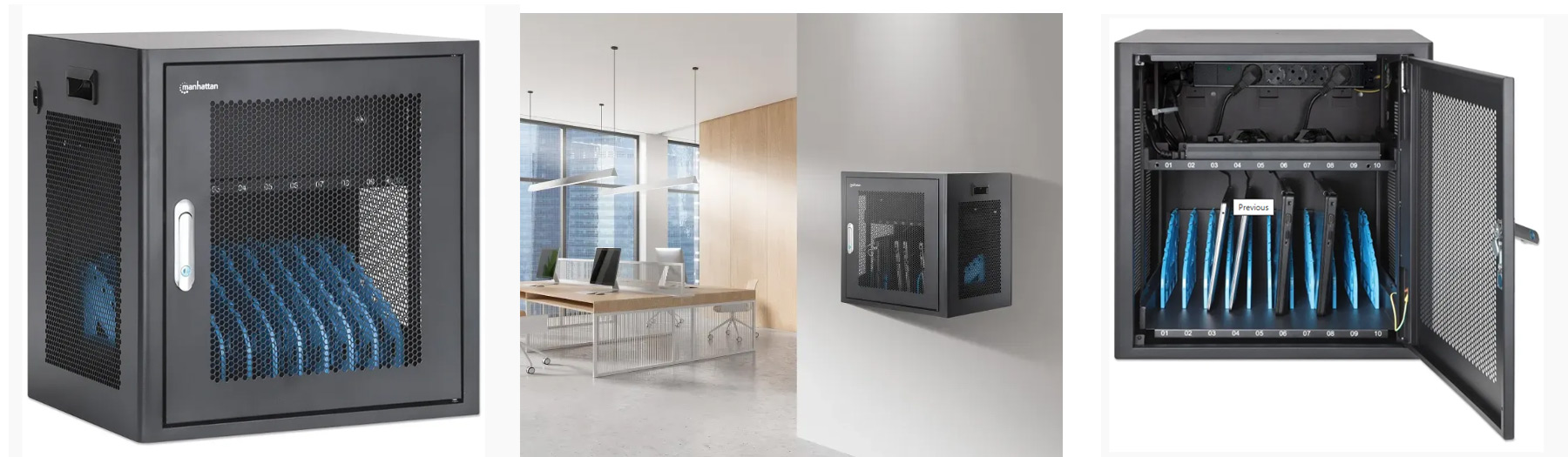
In fifth place is the Manhattan 181204, a compact cabinet that charges 10 laptops with screens up to 16 inches.
Its small footprint suits an office, computer lab or training room that only needs to charge a handful of devices at a time.
It can sit on a desk or be mounted on a wall, giving you a choice when floor space is limited.
View the Manhattan 181204 cabinet for ten 16-inch laptops with ten 230 V AC sockets
4. Formcase TransformerCase T10MLX AC for charging ten laptops on the move
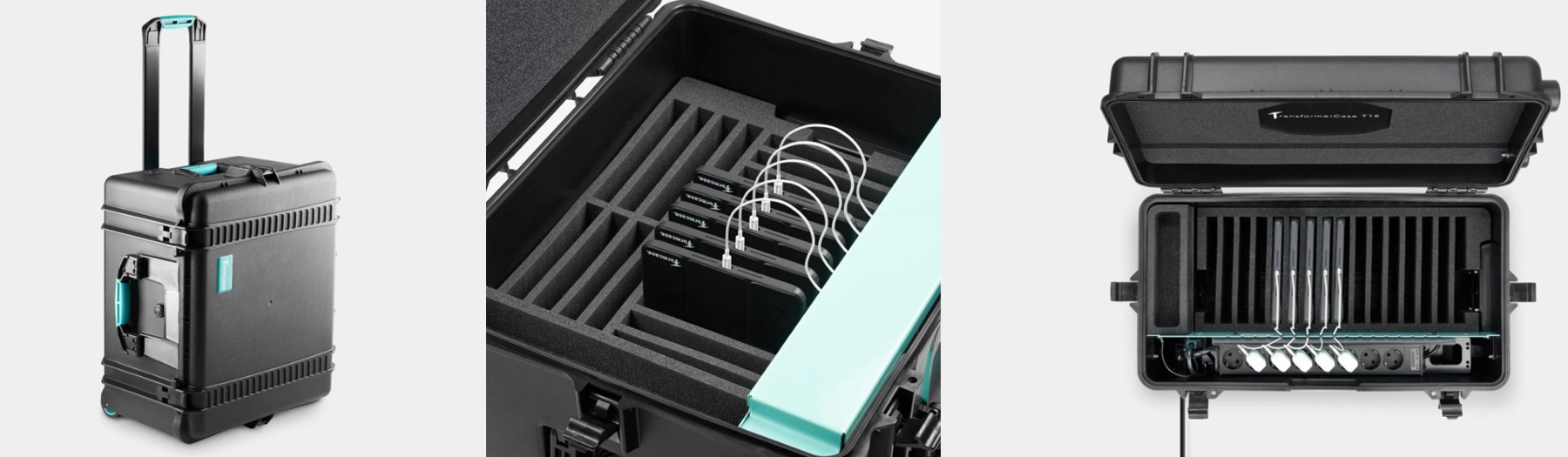
Our fourth pick is a case designed to travel. The Formcase TransformerCase T10MLX AC can store and charge 10 laptops using 230 V AC sockets.
A large stationary cabinet makes less sense when the equipment needs to travel between classrooms, branches or different sites. A mobile case is easier to take along.
The TransformerCase combines transport, storage and charging, so a team can use the same set of laptops at several locations.
View the Formcase TransformerCase T10MLX AC for ten 15.6-inch laptops with ten 230 V AC sockets
3. Manhattan 181198 for laptops up to 16 inches
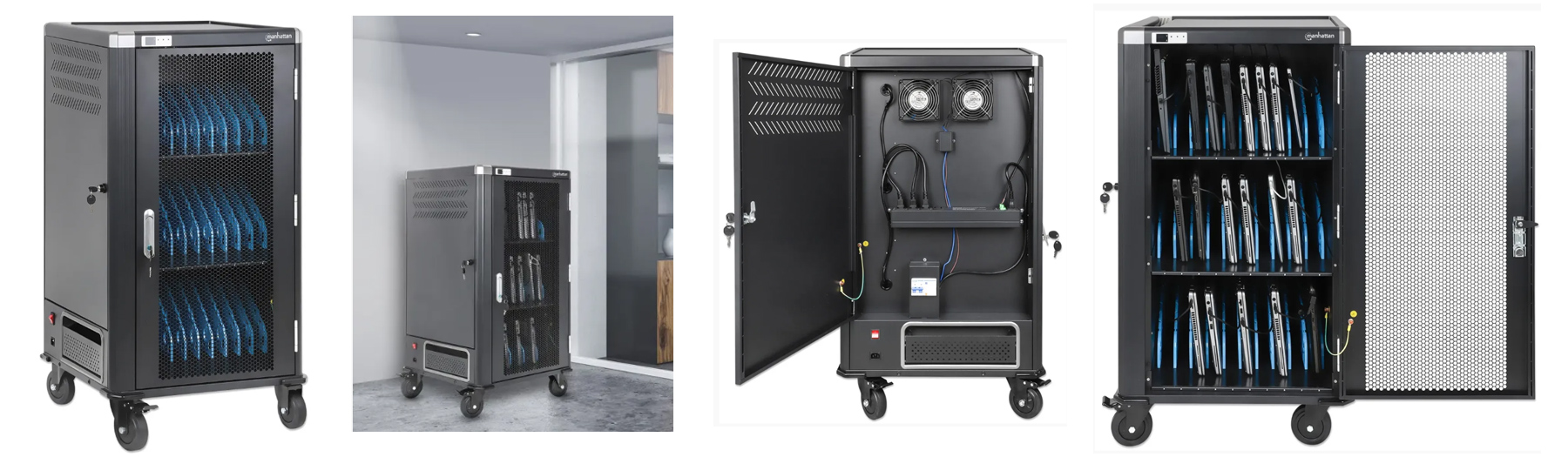
Our third pick is the Manhattan 181198, designed to store and charge 30 laptops with screens up to 16 inches. It is a useful size for organisations that use larger notebooks.
The cabinet uses sequential charging to stagger the start of charging across groups of devices. This limits the initial load on the circuit when a full set of laptops is connected.
The design combines active and passive ventilation to dissipate the heat generated when many devices charge together.
Its electrical protection features include OCP, SCP and OVP for overcurrent, short-circuit and overvoltage protection respectively. A residual current device (RCD) provides an additional layer of protection.
View the Manhattan 181198 cabinet for thirty 16-inch laptops with thirty 230 V AC sockets
2. Ewent EW1701 for 36 devices and quiet operation
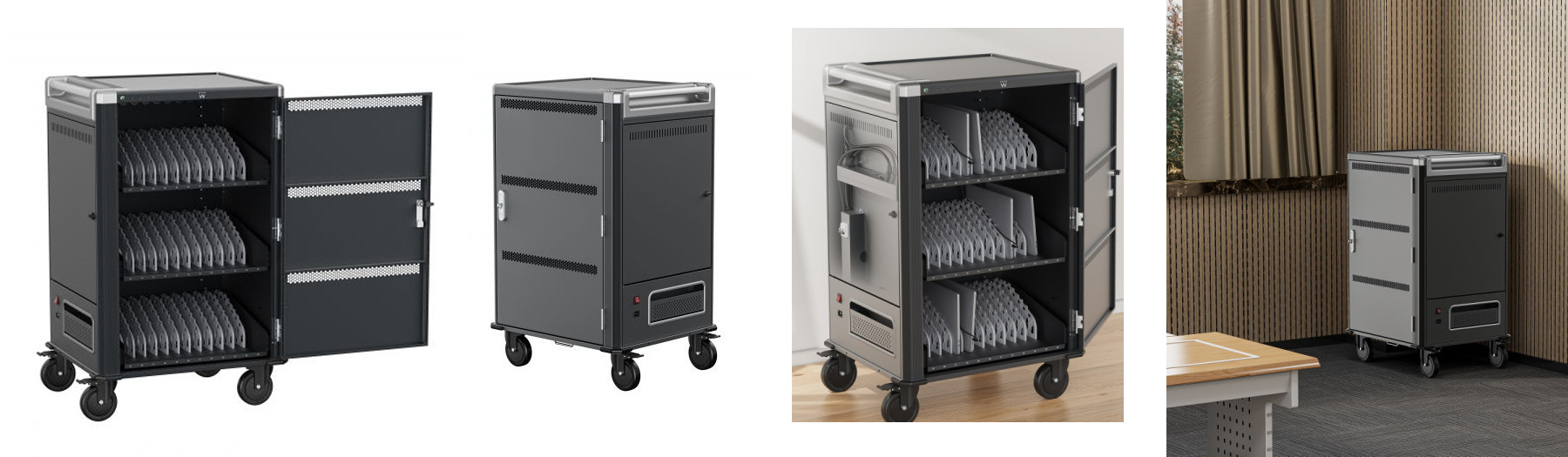
If your priority is capacity, consider the Ewent EW1701. It stores and charges up to 36 devices, making it a practical choice for large computer labs, classrooms or training spaces.
One of its most useful features is sequential charging. The system first checks the current load. If it exceeds 14 A, it charges a third of the cabinet at a time in 15-minute cycles until the load current falls below 14 A.
The Ewent EW1701 also has an ergonomic handle and castors with directional locks and brakes, which make it easier to manoeuvre in busy spaces.
It suits rooms that need high capacity, mobility and quiet operation.
View the Ewent EW1701 mobile charging cabinet for 36 laptops up to 15.6 inches or tablets
1. Techly 108705 for charging 30 laptops
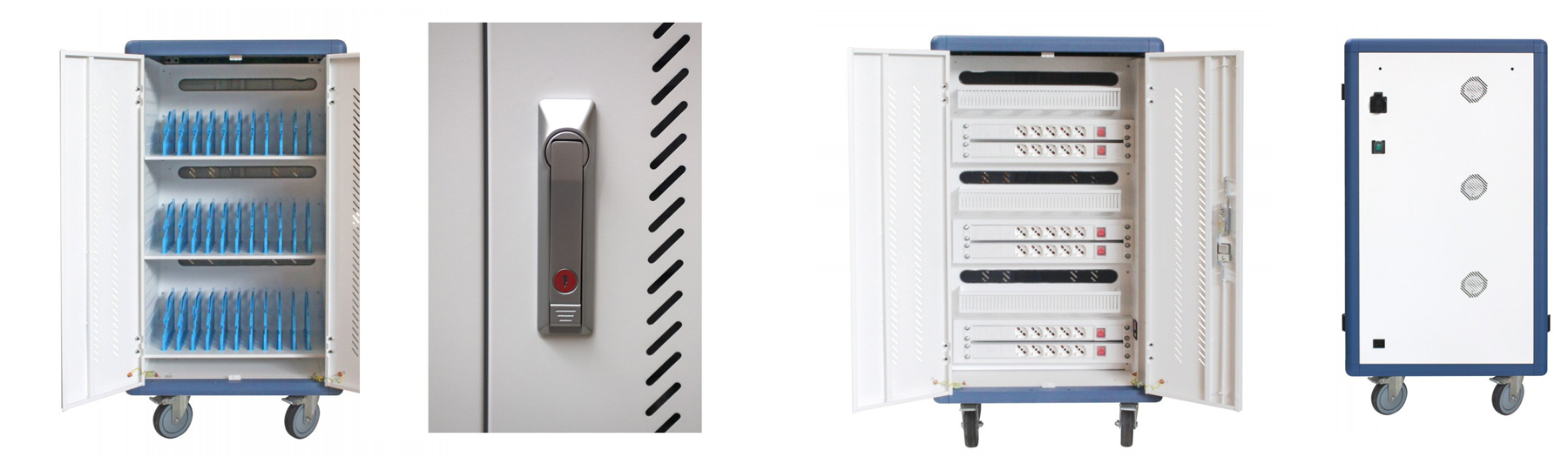
Our first choice is the Techly 108705 (I-CABINET-30DTY). It combines a large capacity with features that help in daily use. It accommodates 30 laptops or tablets and has thirty 230 V AC sockets.
This model suits schools, offices and public institutions. Its soft-start circuit limits the initial current surge when charging begins.
It also has an integrated residual current device for additional electrical protection. Heat is removed by active ventilation, with fans circulating air through the cabinet.
These features make the Techly 108705 a strong all-round choice for anyone managing a larger fleet of devices.
View the Techly 108705
Which charging cabinet should you choose?
Start with three practical questions. Check how many devices you have, how large they are and where the cabinet will be used.
For a versatile cabinet serving a larger fleet, start with the Techly 108705. Its 30 bays come with active ventilation, soft start and a residual current device.
If you need maximum capacity and quiet operation, consider the Ewent EW1701 for 36 devices. Passive ventilation makes it well suited to classrooms and other places where noise matters.
If you use larger laptops, take a look at the Manhattan 181198, which fits devices up to 16 inches and has a range of electrical protection features.
For regular transport between sites, consider the Formcase TransformerCase T10MLX AC. If you only have a few laptops and space is limited, consider the compact Manhattan 181204.
A well-chosen cabinet gives devices, chargers and cables a place of their own and makes it easier to get a full set of laptops ready for the day. Netinet’s range includes sizes and designs for both large school computer labs and small offices.